

It has been over 50 years since the internet changed the way we live. Mostly, it helped human life in having access to nearly every kind of information. On the other hand, the wide consumption of the internet and the technology generated carbon footprint with every single click. So what is the invironmental impact of digitalisation ?
In the era of Internet Of Things (IoT), (i.e. physical devices being connected and controlled by a software technology without the need of human interaction) resulted in the exponential increase in the carbon footprint due to the excessive use of technology.
In the debate on climate change, the effect of digitalization on the climate is mainly neglected. The energy consumed by the internet is humongous, if we were to imagine the Internet as a country it would be the sixth largest to consume energy.
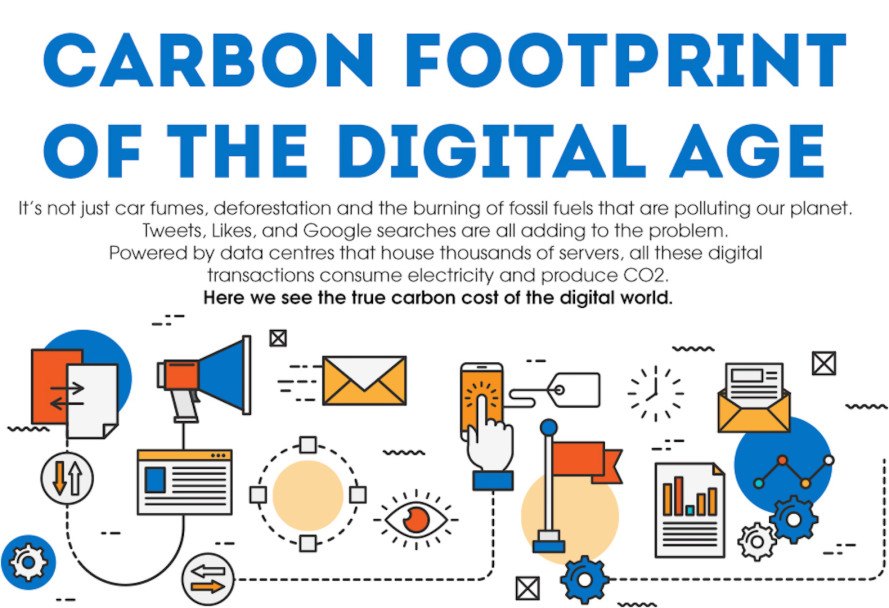
The aftermath of digital pollution is varied. It affects the environment as it contributes to the rising global temperature. Based on a study conducted by “GreenIT”, published in September 2019, the environmental print of digitalization is the following:
- 6 800 TWh Primary energy;
- 1,400 million tonnes of greenhouse gases (GHG);
- 7.8 million m3 of freshwater (Water);
- 22 million tonnes of antimony (ADP).
What is Green IT?
Green-IT is a concept that takes place on two major fronts:
On the one hand, it is the set of technologies that allow companies to reduce their carbon footprint, reduce their greenhouse gas emissions, their energy consumption, etc. In short, these are all the technologies that will make it possible to reduce the environmental impact in the field of Information technology.
On the other hand, it is the economic, social, and philosophical principles and policies that are adopted in eco-responsible companies to promote sustainable development.
We can, therefore, define Green-IT as a responsible concept intended for particular IT firms aiming to reduce the impacts on our planet by means of simple gestures.
Why companies adopt Green IT strategies?
Cost savings are one of the main reasons why green IT has taken off in large organizations.
Reducing spending on equipment, energy, and even tax breaks and other financial incentives make green IT much more convenient and attractive to businesses.
The regulations established to combat climate change have forced companies to change their behaviour and become ecological.
As a result, new economic opportunities came into the picture. Companies can enter the market and increase their income and employment growth by providing or servicing energy-efficient equipment, or by developing green technologies, for example.
Furthermore, it is not surprising that green technologies are just good public relations for companies. Customers and stakeholders care about the environment and the effects of global warming, so companies that show good initiative in this area show that they are receptive and take action.
How does France supports green IT?
Green computing and eco-computing are still young concepts, for which global regulations have started to emerge in recent years. The impacts of sustainability requirements on IT can relate to equipment or business processes, they exist in several standards or regulations. In France, in December 2008 the government produced the first report on ICT (Information and Communication Technologies) and sustainable development, which focuses on the first issue, that of energy savings and the ability to recycle IT equipment. The report formalizes the eco-ICT term as a French translation of green IT.
For IT equipment:
- The Basel Convention (website), adopted in 1989 and aims to control the movement of hazardous waste and reduce its quantity.
- The Stockholm Convention (website) concerns POPs (Persistent Organic Pollutants) and aims to control and reduce or ban certain polluting products.
- The European WEEE directive (Waste electrical and electronic equipment) targets the management and treatment of electrical or electronic waste. It is at the origin of the introduction of the ecotax or eco-participation paid by the consumer when purchasing his equipment.
- The European RoHS directive (Restriction of the use of certain Hazardous Substances in electrical and electronic equipment) seeks to limit the use of dangerous substances in electrical or electronic equipment and oblige producers to reduce the use of 6 dangerous substances (lead; mercury; cadmium; hexavalent chromium; polybromobiphenyls; polybromodiphenyl ethers).
- The Energy Star is a program in the United States aimed at reducing the energy consumption of electronic equipment.
How can we reduce our carbon footptint?
- Think about turning off your appliances at night.
- Choose a computer that will consume as little power as possible. This will not help your wallet, but it will help the planet (choose medium-sized screens, because the bigger it is, the more it will consume), check if the device you buy can be recycled or not. (Beware of the false green labels that some companies dare to adopt to improve their image).
- make sure to put your computer on sleep mode rather than the battery saver.
- Think about recharging ink cartridges, rather than disposable cartridges. (It will cost less, and you will participate in the development of computer ecology).
- Apply best practices in email use and web browsing like: keep only essential emails; unsubscribe from unnecessary newsletters; limit the recipients to what is strictly necessary; take the time to properly formulate your requests.
What is the future of Green IT ?
Nanotechnology undeniably represents the future of Green IT. Green nanotechnology refers to the use of nanotechnology to improve the environmental sustainability of processes that produce negative externalities. It also refers to the use of nanotechnology products to improve the sustainability of IT products. This includes the manufacture of environmentally friendly nanoproducts and the use of nanoproducts in support of sustainability.
Réferences :
N’hésitez pas à Consulter notre blog pour plus d’article :



0 commentaires